Of course The Life of Jeremy Dodo is fiction, but our feathered hero exists in a definite time and place — and he interacts with several historical figures. Even so, I had fun concocting numerous fanciful names and literary works and mingling them with the authentic ones.
Here’s your key to separating the factual from the fictitious as you read the book. (You might want to consult this list during your reading.)
Fact:
Marcus Tullius Cicero (106-43 BC), commonly called “Tully” in Jeremy Dodo’s time, was a renowned Roman statesman, orator and writer. Jeremy claims to have admired him once, but now finds him to be “a dull and gaseous Fellow, suited for aught but to speechify in our Parliament.”
William Shak(e)spe(a)r(e)’s name has been spelled half a dozen ways through the years, including variations by the man himself. His Globe Theatre was destroyed by fire in 1613, rebuilt in 1614, and demolished by the Puritans in 1644. Jeremy and friends track down its original location.
The Earl of Essex (Robert Devereux, 1565-1601) and Guy Fawkes (1570-1606), both were executed for treason and beheaded.
Robert Burton (1577-1640), author of the encyclopedic The Anatomy of Melancholy, and Sir Thomas Browne (1605-1682), a brilliant essayist who coined numerous English words, were early influences on Jeremy when he labored as a translator at the sultan’s court in Constantinople. Jeremy also admired English poets John Milton (1608-74), Abraham Cowley (1618-1667) and John Wilmot, the Second Earl of Rochester (1647-1680).
John Dryden (1631-1700) was the leading poet of his era, best known for The Fairie Queene.
Sir Christopher Wren (1632-1723) is just possibly England’s greatest architect. His graceful churches, built after the devastating fire of 1666, shaped the skyline of London.
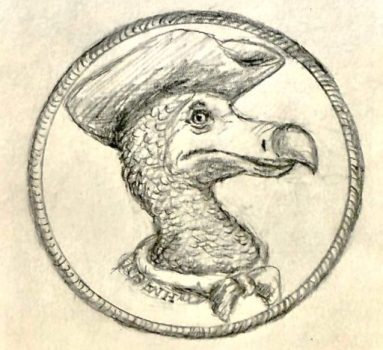
Richard Hogarth ran a short-lived coffee house at St. John’s Gate and was imprisoned for debt. His son, William Hogarth (1697-1764) became a noted artist, famous for his trenchant views of London life. (Alas, he didn’t actually sketch that portrait of Jeremy Dodo.)
The Duke of Marlborough (1650-1722) was a celebrated war hero and ancestor of Winston Churchill.
Daniel Defoe (1660-1731) is famous as the author of Robinson Crusoe and Moll Flanders, although he should be equally famous for his journalism.
Queen Anne (1665-1714) ruled the British Empire from 1702 until her death.
Dr. John Arbuthnot (1667-1735) was a physician, satirist and polymath who counted most of the London Wits among his friends.
Jonathan Swift (1667-1745) needs no introduction. Brilliant satirist and author of the immortal Gulliver’s Travels.
Joseph Addison (1672-1719) and Sir Richard Steele (1671-1729) collaborated on The Spectator, a hugely popular daily periodical, from March 1711 to December 1712.
John Gay (1685-1732) is best known for his groundbreaking satirical musical, The Beggar’s Opera.
Alexander Pope (1688-1744) was perhaps the dominant English poet of his time, famous for his scathing wit. Due to his spine deformity, he stood 4 1/2 feet tall.
Lady Mary Wortley Montagu (1689-1762) was a prominent socialite and writer who earned a niche in medical history by advocating the introduction of smallpox inoculation in England.
Sir William Humfreys (d. 1735) was a politician who served as Lord Mayor of London, 1714-1715.
Mauritius is a small island in the Indian Ocean, and it was the dodos’ only known home.
Grub Street was notorious as the dwelling place of hack writers, would-be poets and low-end publishers. It was later renamed, bombed in World War II, and transformed by modern developers, so that very little of the original street remains.
Chiswell Street, the site of Jeremy’s garret during his early years in London, crossed the north end of Grub Street. It still exists, and it’s considered prime real estate today.
Hampton Court Palace, located on the Thames several miles west of central London, was the residence of William III and Mary II during the 1690s, and its original garden maze is still a popular tourist destination.
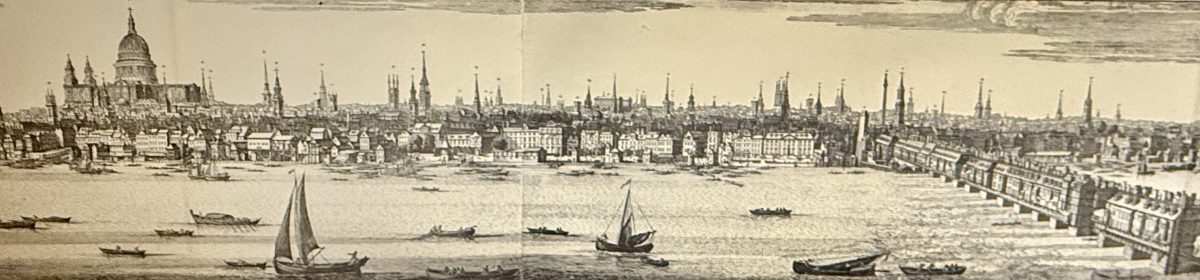
London Bridge was lined with houses and shops until it was cleared c. 1760… although food vendors were discouraged from setting up shop there. The bridge has been replaced twice since then.
St. Paul’s Cathedral, completed in 1710, is Christopher Wren’s masterpiece. Its great dome has dominated the London skyline for over 300 years.
Bethlehem (or Bethlem) Royal Hospital (a.k.a. Bedlam), was London’s notorious insane asylum, founded in the 13th century. From 1676 to 1815 it was located in Moorfields; Jeremy and friends would have visited that location.
Will’s Coffee House was famous in its day as a gathering place for the “London Wits.” It had already declined in popularity by the time I had Jeremy make his entrance there in 1711, so I stretched its prime by a few years.
Salutation Tavern emerged as a popular literary hangout after Will’s Coffee House declined.
All the songs sung by Jeremy and friends on the way home from the Jolly-Dogg Tavern were popular in the early 18th century.
Fiction:
Every character and author not mentioned above, including Cubbidge and Meatley, those “immortal men of verse.”
Every literary work named in the book, with the exception of The Spectator, Steele’s Bickerstaff Papers, Dr. Arbuthnot’s History of John Bull, and Pope’s poems Essay on Criticism and The Rape of the Lock.
In Portsmouth: The King-Neptune Inn, Dr. Bustard’s Marvells and Cheapfields Hall.
In London: The Saracen’s Head, The Sign of the Turk’s Nose, The Jolly-Dogg, and Frogger’s Coffee-House.
 The Life of Jeremy Dodo